Fallout 4 Modern Military Armor
Armor protection is extraordinarily important in Fallout 4, providing resistance to physical, energy, and radiation damage. Fallout 4 body armor comes in two types: complete suits and layered. PC version of Modern Firearms 2.5 Beta-1.1 Version 2.5 preview: v2.5 is already running in alpha testing on 3dm forum, a beta testing on this site will be released after I have dealt with those found bugs.
- Fallout 4 Modern Military Armor Mod
- Fallout 4 Modern Warfare Armor
- Fallout 4 Modern Military Armor Mod
| This is a lore summary, presenting intradiegetic or in-universe information about the subject. For game characteristics and similar data, consult the table on the right. |
|
Combat armor is a general term for any suit of personal body armor employed before the Great War by the United States Armed Forces. Although offering varying degrees of protection, sophistication, and encumbrance, the combat armor is typically among the finest possible options when it comes to personal protection, as it was designed to secure the operator without limiting their protection or fine motor control.[1]
For game-specific articles, see:
- 7Operators
- 7.2Post-War
- 9Gallery
Design[editedit source]
Modelled after the human silhouette and designed to provide balanced protection that does not limit mobility on the battlefield, combat armors are a diverse family of personal body armor of varying degrees of sophistication, from the earliest iterations of the armor developed by the United States Army[2] to the cutting-edge riot gears that came into use prior to the Great War.[3]
Army combat armor[editedit source]
The first modern type of combat armor developed by the United States Army[2] to the cutting-edge riot gears that came into use prior to the Great War.[4] consisted of individual armored plates manufactured from synthetic fibers[5] attached to standard load-carrying equipment of the infantryman. The individual components included a combat helmet issued with matching goggles in hazardous environs, front and back ballistic plates, and a pair of axillary protectors. Additional forearm protectors were issued to frontline troops.[6] The lower body was protected by a pair of thigh plates, worn together with a groin and kidney protector. The shins, knees, and feet were covered by frontal plates worn over standard combat boots.[7]
The armor was typically worn in conjunction with standard Army fatigues[8] or specialized uniforms designed for it, with various solid color camouflage patterns (including Arctic white, coyote brown, and olive drab). Rank indicators were typically painted on the axillary protectors,[9] with the Army insignia and identification numbers printed on the back plate.[10][7]
Standard combat armor
Winterized variant
Medic variant of the winterized combat armor
US Army combat armor
Tenpenny security uniform
Rivet City combat armor
Talon Company armor
Ranger battle armor
Van Graff combat armor
Standard combat armor[editedit source]
- Gameplay articles: Combat armor, Sturdy combat armor, Heavy combat armor
The success of the Army combat armor paved the way for superior models. The most important of these was the general purpose combat armor issued to military units nationwide,[11] with the first Army model relegated to domestic and garrison duties.[2] to the cutting-edge riot gears that came into use prior to the Great War.[12]
The new combat armor was manufactured in three different variants, for wearing with the standard armed services uniform: Light, medium (sturdy), and heavy. The modular suit of armor was manufactured from alloys that offer balanced protection from conventional firearms and energy weapons[13] and provide load-bearing functionality in combat. A new combat helmet model was designed for all three variants, incorporating ear protection and a pair of attachment points for additional equipment, such as lamps (commonly found on surviving units) and targeting or imaging equipment.[14]
The basic, light model was most common, issued widely to troops on the battlefield.[15][11], it consisted of a pair of plates covering the chest and upper back, attached to standard load-bearing equipment, axillary protectors, and a pair of plates covering the thighs.[16] The superior, sturdy combat armor variant was the baseline model. The torso assembly is enhanced with the inclusion of soft body armor from ballistic fiber, overlaid with enlarged hard armor plates providing superior coverage and protection. A groin protector is included by default. Limbs incorporate the axillary and thigh protectors of the lighter model, with the addition of plating on forearms, knees, and lower legs. The entire assembly was intended for units engaged in heavy fighting on the most contested fronts.[17]
The heaviest model of combat armor is a radical departure from the principle of balance that guided the design of combat armor. Emphasizing durability and protection, the heavy variant encloses the entire body in a layer of soft body armor enclosing it almost entirely, with the characteristic armored plates worn on top. The torso assembly incorporates the medium variant upgraded with armor plating enclosing the entire torso, including a characteristic hump that protects the upper back. Arms are sheathed in segmented armor that incorporates additional protection for hands, elbows, and shoulders (heavy axillary protectors include a pair of characteristic pauldrons). Legs are protected even more heavily, with armor plating enclosing the thighs, lower legs, and covering feet.[18]
The standard combat armor was designed to accept numerous modifications, allowing for it to be tailored for specific purposes. Common material included additional reinforcement, “shadowing” (reducing its profile and signature, with a characteristic black finish), and an optional polymer upgrade that replaced the standard combat armor alloy with advanced combat polymers. Functional upgrades were numerous, tailoring the armor's functionality to the mission profile and included special linings (fire-retardant asbestos, radiation-resistant lead, or the unique BioCommMesh enhancing combat drug duration), lightened construction, upgraded combat webbing, melee modifications, weapon stabilization, and various customizations of the armor profile and silhouette to improve performance in close combat.[19]
After the Great War, some factions developed their own modifications. For example, the Brotherhood of Steel armors incorporate a special coating that provides additional protection from background radiation.[19]
Advanced combat armor[editedit source]
Even with the widespread deployment of standard combat armor, work continued on more advanced suits of combat armor. The largest and most successful model was a high-tech armor using advanced defensive polymers to provide a high degree of protection,[20][21] also referred to as battle armor[22] and reinforced combat armor.[23] The advanced model represented a new approach to design, doing away with the modular construction of its predecessors, and was hailed as an advanced personal armor for the 22nd century police officer or soldier: Highly effective against most types of damage and lightweight, unlike the heavy variant of the standard combat armor. Unlike older models, materials used in the advanced combat armor also provided limited protection from radiation by default[24][25] and typically incorporated some form of camouflage by default.[26]
The basic component of this advanced armor is a long-sleeve jumpsuit, incorporating thermal dissipators and general purpose dissipative membranes.[27] It is worn underneath the actual combat armor, manufactured from polymer impact plates providing concussive protection and incorporating additional dissipation cells and membranes.[28][29] The top layer incorporates a single-piece vest enclosing the entire torso, a pair of axillary protectors, armored boots, forearm protectors, and a ballistic helmet with an integrated laser targeting system and a polarized visor. Compared to its older brother, the design is a lot more mobile, with limbs protected by soft armor that doesn't limit fine motor control and agility, and crucial areas of the body hidden under hard armor. The organic, rounded shapes of the armored shell also improve its protective qualities as compared to more angular past models.[30]
Although the advanced combat armor was never fielded in large enough quantities to supplant the standard combat armor, additional variants were created. The combat armor mark II is a heavier set designed for use by shock troops and Special Forces, incorporating additional armor plating and increasing its protective qualities. After the Great War, the Brotherhood of Steel created its own variant that incorporates superior materials and design. Easily recognizable due to polished rivets incorporated into its pauldrons and the blue trim on the edges.[31]
A set of advanced armor
Full view
Mk 2 set
Full view
Brotherhood variant
Marine armor[editedit source]
An advanced model of combat armor designed for the United States Marine Corps,[32] the Marine armor pulls no stops when it comes to providing protection for the user, above even that of the heavy combat armor. Outclassed only by Power Armor, every piece of was designed to provide exceptional protection in nearly every battlefield scenario.[33]
Unlike the standard or polymer combat armor, this variant relies on a combination of hard and soft armor to provide protection. The torso assembly consists of a tactical vest from ballistic fiber covering the entire torso from the groin to the shoulders and neck, supplemented by tactical rigging combining hard ballistic armor with a powered survival system and a belt with four multipurpose pouches. Arms are protected by sleeves from the same ballistic fiber, combined with hard armor covering the shoulders, forearm, and dorsal side of the hands. The hard armor is shaped to provide additional protection from the front when aiming and double as attachment points for additional carry pouches. The legs are protected in the same way, with the added benefit of thigh pouches and a pair of stabilizers on the shin. The helmet is derived from the standard combat armor variant, combing by default with a polarized visor, filtration mask, and additional carry strap on the back of the head. Together, they combine to provide a heavy duty set of combat armor that covers almost the entire body in heavy armor, excepting necessary articulation points.[34]
Riot gear[editedit source]
Another advanced design fielded in limited quantities before the Great War, riot gear was a specialized model of combat armor used by the United States Marine Corps,[35] Army units in the American West,[36] and select law enforcement agencies, such as the Los Angeles Police Department.[37]
The most characteristic element of this model is the helmet. A rounded shell protects the head from incoming gunfire, while the lamps on the right side of the helmet (including infrared and visible light projectors) provide illumination.[38] The armored mask designed to be worn with the helmet is necessary to use the IR lamp, due to the low-light optics integrated into the lenses.[39][40] The mask also incorporates a locking mechanism to properly join it together with the helmet shell, ear covers with membranes that do not inhibit hearing while maintaining its protective qualities, and air filters. Some upgraded models also include communications gear and upgraded filtering apparatus.[41]
The torso assembly is a flexible vest of rigid impact plates, worn with adjustable straps on the sides and shoulders. One of its most notable additions is a prominent throat protector mounted on the vest, used by military operators to display tactical numbers[42] or the owner's identifying information, such as the name, rank, and blood group, allowing for easy casualty management.[43] Later models of riot gears may include heavier protection, including armored plating on shoulders and forearms. Military coats designed for use with the armor will also typically include some form of bullet-resistant reinforcement.[41]
Helmet and vest of the USMC combat armor
Side of the USMC-issued combat armor
Desert Ranger combat armor, combining a salvaged duster with jeans and a set of USMC desert armor
LAPD riot gear combined with the traditional Desert Ranger duster
Military-issue riot gear
Advanced version of the riot gear
Elite riot gear
Operators[editedit source]
Pre-War[editedit source]
The United States Armed Forces were the principal operator of the entire family of combat armors before the Great War, although some were provided to law enforcement agencies. It was not available to civilians without a special permit provided by the BADTFL.[25]

- United States Army: The main operator of the entire family of combat armor: starting with the US Army combat armor and its specialized variants, the winterized combat armor and winterized medic armor,[44] through the standard combat armor, to the most advanced suits such as the advanced combat armor,[45]combat armor Mk II,[46]riot gear, veteran riot gear, and elite riot gear.[47]
- United States Marine Corps: Employed riot gears adapted for desert use.[48]
- Canada: At least one Canadian used the advanced combat armor for personal protection, before his capture and execution on national television. The source of the suit is not known.[49]
Post-War[editedit source]
States and municipalities[editedit source]
- Brotherhood of Steel: The largest operator of combat armors, principally the Army, standard, and advanced combat armor. Basic combat armor was usually used with the standard woodland camouflage,[50] while standard armor was deployed with a custom, copper-colored finish providing additional resistance to radiation.[51] The most advanced armor of this family was the Brotherhood armor, an upgraded variant of the basic version. Manufactured by Brotherhood Knights, it looks like normal Combat Armor, but is made of substantially improved materials and is designed better.[31]
- Enclave used advanced combat armor as standard equipment for its light infantry stationed on the mainland.[52]
- Vault City provided suits of advanced combat armor to its patrols operating away from the City itself.[53]
- New California Republic Rangers used advanced combat armor in 2241,[54] but by 2281, after being folded into the NCR military command, switched to hand-made combat armor pattern suits, with LAPD riot gears provided to its veteran members.[55]
- Rivet City's security guard all used Army combat armor painted black with riot helmets as its security uniform in 2277.[56]
- The wealthy merchant houses of the Hub provided full suits of advanced combat armor to the Hub Police in 2161.[57]

Non-state actors[editedit source]
- Some wealthy merchants would continue the practices of providing their security detail with combat armor, such as Duppo in 2242, with advanced combat armor,[58] or Allistair Tenpenny in 2277, who provided his security with security uniforms in characteristic beige.[59]Van Graffs also wore black combat armor for brand recognition.[60]
- The Gun Runners provided combat armor for all of its security between 2161 and 2281.[61]
- Various mercenary units and other groups throughout the centuries made use of combat armor of all types. Notable examples include Bishop's mercenaries, Darion's elite New Khans, and the Hubologists of 2241, Talon Company and Reilly's Rangers of 2277, as well as Gunners of 2287.[62] Individuals would also be able to purchase an intact suit with increasing ease, due to the increased availability of suits on the market (although prices are typically high).[63]
Behind the scenes[editedit source]
“Wes Burt (for Massive Black) developed the design. I shared your concerns, so there were a few things I requested to keep it from turning into Jin-Roh Part 53. First, I asked that he wear jeans and boots. I also requested that he should typically have a revolver or lever-action rifle with a bandoleer for bullets. Last, I asked for his jacket to be dark brown, not completely black. I wanted to pull some of the color elements toward warmer 'cowboy' tones instead of strict neutrals.
Wes is a really fantastic artist and I think he did a great job.
”— J.E. Sawyer on the veteran Ranger armor's designGallery[editedit source]
Concept art[editedit source]
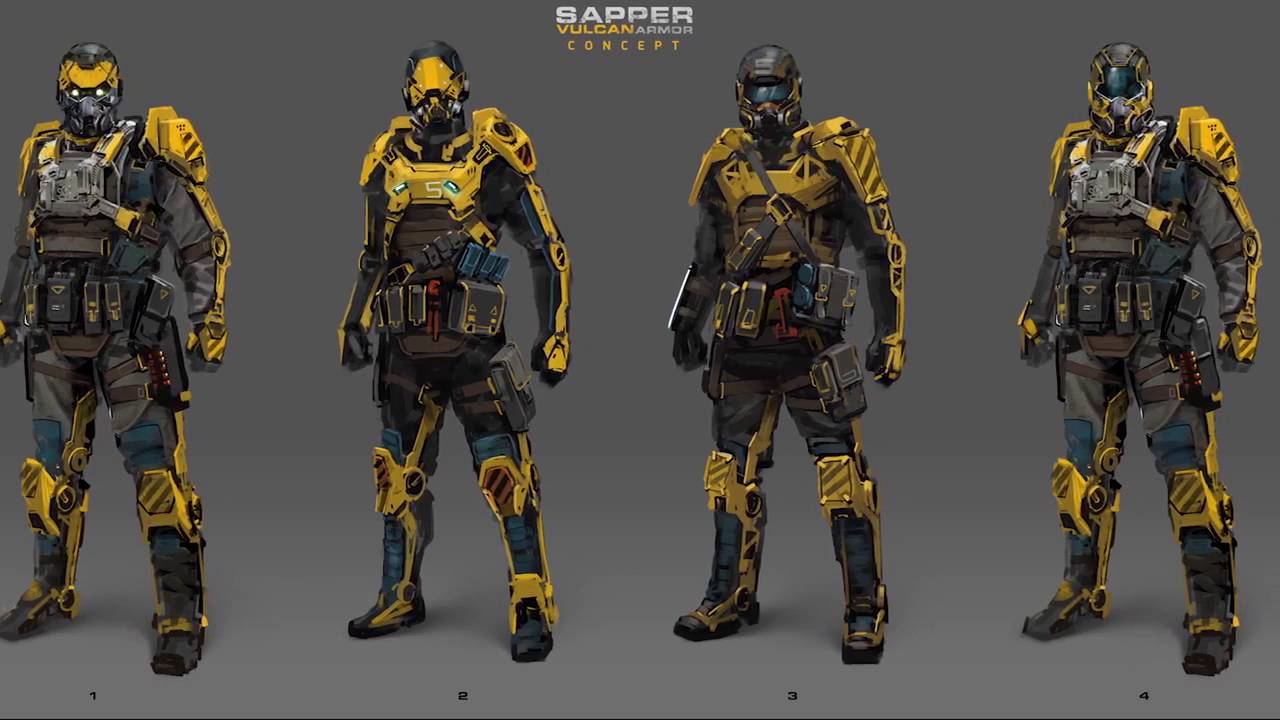
Fallout 4 concept art
Fallout 3 concept art by Adam Adamowicz
Combat armor ad from Fallout d20
Renders and game assets[editedit source]
Promotional wallpaper
Fallout: New Vegas main menu background
NCR Veteran Ranger wielding a .357 magnum revolver
NCR Veteran Ranger holding an anti-materiel rifle
NCR Veteran Ranger in the Fallout: New Vegas trailer
NCR Ranger combat armor concept art
Ranger helmet concept art
NCR Propaganda showing the Ranger helmet
Two NCR Veteran Rangers wearing the NCR Ranger combat armor can be seen in the All Roads cover, one at the end of the broken 'Welcome' sign and the other to the right, near the edge of the image and the back of the pick-up truck
Pip Boy icon of the Ranger helmet
References[edit source]
|
Are there any good Army bases that have ammo, medical supplies, and power armor?
If so, where are they located?
Kodama1 Answer
There are several military locations with power armor throughout the Commonwealth. Not all of them are named locations with fast travel waypoints. For example, there is a crashed vertibird with a suit of power armor next to it west of USAF Satellite Station Olivia. I'll list a few of these of which I'm aware, but I don't know of any list to reference to find the other ones.
Below is a list of power armor locations in the Commonwealth that are associated with the military. Ammo and medical supplies can be found in random containers, so there may be some there whether any is listed on the wiki or not, but I'll list any noted on the wiki.
Named Locations
There's power armor in the green container in front of the stockpile. There are a lot of supplies throughout the area. I'm sure you'll find ammo and medicine.
There's power armor at the bottom of the silo. You can get ammo off the synths, if nothing else. Probably some medicine.
This is found in the Automatron DLC. There's a suit of leveled power armor between two expert locked gates, between the tank room and shelved radioactive barrels. There are some mini-nukes and a Fat Man, so that's ammo. No idea if there's any medicine.
Part of this area can't be entered until you initiate a specific quest for the Brotherhood. There's power armor in the small guardhouse before the bridge to Fort Strong, so it's not actually inside. Inside you will definitely find ammo and I'm pretty sure there's some medicine in there as well.
There are two different power armor suits here. On the western side of the area, outside, behind an expert locked security gate is one. There is an armory outside the main building, to the northwest. Inside, behind the terminal-locked door, you'll find another suit. There are enough containers in the main building I'm sure you'll find some ammo and medicine.
I'm not 100% sure that this is actually a military installation, but it could be. One of the satellite dishes has stairs going all the way to the top. There's a power armor frame up here, but no pieces on it. The super mutants should have ammo on them. Not sure if you'll find any medicine.
Behind the structure is a full suit of power armor behind an Expert terminal. I think I recall a first aid box on the wall. There's a locked safe inside, which should probably have ammo in it.
Other Places
These are basically just off the top of my head. If anyone knows somewhere I could look for a better list, or has another to add, please leave a comment.
- Crashed Vertibird
There's a crashed vertibird with a suit of power armor near it west of USAF Satellite Station Olivia.
- South Boston Road Checkpoint
I recall finding a rusting suit of power armor southwest of the South Boston Military Checkpoint, along the road, near some personnel carriers.
- Natick Road Checkpoint
I recall finding a rusting suit of power armor along the southern part of the road that runs west of Lake Cochituate, near some personnel carriers.
DCShannon