What Is A Good Windows Experience Index Score
| Developer(s) | Microsoft |
|---|---|
| Operating system | |
| Platform | x86, x86-64 |
| Type | Computer performance measurement |
| Website | Windows System Assessment Tool at MSDN |
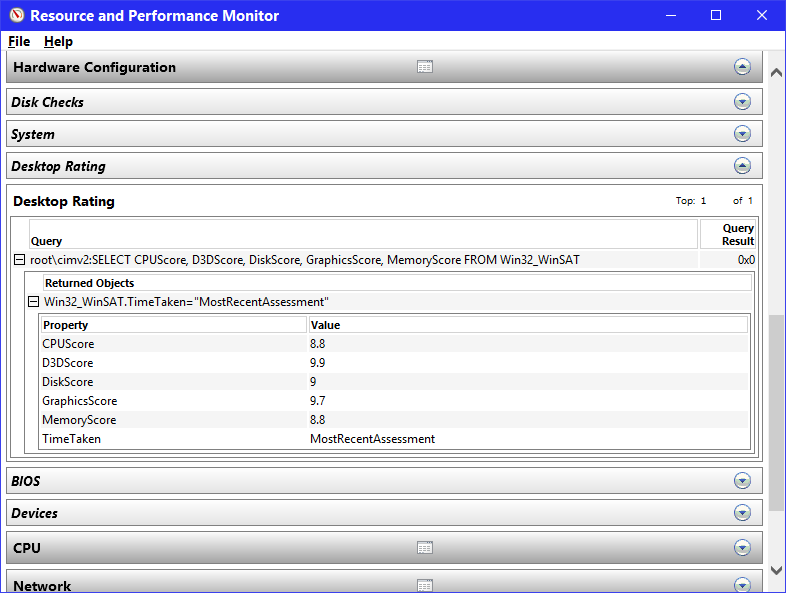
The Windows Experience Index was basically a test that would put key system components such as your CPU and GPU through the ringer and then rate them on a scale of 1.0 to 9.9, with the lowest score that your computer got in any given category becoming your base score. Wei is a total waste of time but we all do it im getting 7.6/7.8/7.7/7.7/7.9 as fatboyslimer said benchmarks is the way to go. Download vantage/3dmark/3dmark11 all from my sig below. Lots of monitoring software there as well.
The Windows System Assessment Tool (WinSAT) is a module of MicrosoftWindows Vista, Windows 7, Windows 8 and Windows 10 that is available in the Control Panel under Performance Information and Tools (except in Windows 8.1 & Windows 10). It measures various performance characteristics and capabilities of the hardware it is running on and reports them as a Windows Experience Index (WEI) score. The WEI includes five subscores: processor, memory, 2D graphics, 3D graphics, and disk; the basescore is equal to the lowest of the subscores and is not an average of the subscores.[1][2] WinSAT reports WEI scores on a scale from 1.0 to 5.9 for Windows Vista,[3] 7.9 for Windows 7,[4] and 9.9 for Windows 8 and Windows 10.[5]
The WEI enables users to match their computer hardware performance with the performance requirements of software. For example, the Aerographical user interface will not automatically be enabled unless the system has a WEI score of 3 or higher.[6][7]
The WEI can also be used to show which part of a system would be expected to provide the greatest increase in performance when upgraded. For example, a computer with the lowest subscore being its memory, would benefit more from a RAM upgrade than adding a faster hard drive (or any other component).[2]
Detailed raw performance information, like actual disk bandwidth, can be obtained by invoking winsat from the command line. This also allows only specific tests to be re-run.[8] Obtaining the WEI score from the command line is done invoking winsat formal, which also updates the value stored in %systemroot%PerformanceWinSATDataStore.[9] (The XML files stored there can be easily hacked to report fake performance values.[10]) The WEI is also available to applications through an API, so they can configure themselves as a function of hardware performance, taking advantage of its capabilities without becoming unacceptably slow.[11]
The Windows Experience Index score is not displayed in Windows 8.1 and onwards because the graphical user interface for WinSAT was removed in these versions of Windows, although the command line winsat tool still exists and operates correctly along with a final score when launching the command 'shell:games'.[12] According to an article in PC Pro, Microsoft removed the WinSAT GUI in order to promote the idea that all kinds of hardware run Windows 8 equally well.[13]
History[edit]
At the 2003 Game Developers Conference Dean Lester, Microsoft's General Manager of Windows Graphics and Gaming, stated in an interview with GameSpot that Microsoft intended to focus on improvements to the PC gaming experience as part of a new gaming initiative for the next version of Windows, Windows Vista, then codenamed 'Longhorn.' Lester stated that as part of this initiative the operating system would include a games folder that would centralize settings pertinent to gamers and, among other features, display driver streamlining, parental controls for games and the ability to start a Windows game directly from optical media during installation—in a manner similar to games designed for a video game console. Microsoft would also require a new method of displaying system requirements on retail packaging for Windows games with a rating system that would categorize games based on a numerical system.[14] In 2004, Lester expanded further on Microsoft's intentions by stating that the company would work with hardware manufacturers to create PCs for Windows Vista that used a 'level system' to designate the performance and capabilities of a system's hardware and that Xbox 360 peripherals would be fully compatible with the operating system.[15] The Windows Experience Index feature in Windows Vista relies on measurements taken with WinSAT to provide an accurate assessment of a system's capabilities—these capabilities are presented in the form of a rating, where a higher rating indicates better performance.
Preliminary design elements created for Microsoft by Robert Stein in 2004 suggest that WinSAT was intended to rate a user's hardware during the out-of-box experience;[16] this is a design decision that would be retained for the operating system's release to manufacturing.[17]
During the Windows Hardware Engineering Conference of 2005, Microsoft formally unveiled the existence of WinSAT and presented it as a technology not only for games, but one that would allow Windows Vista to make decisions, such as whether to enable desktop composition, based on a machine's hardware capabilities.[18][19][20] WinSAT would remain a key focus throughout development of the operating system before its release to manufacturing.[17]
What Is An Index Score
Tests[edit]
WinSAT in Windows Vista and Windows 7 performs the following tests:
- Direct3D 9 Aero Assessment
- Direct3D 9 Batch Assessment
- Direct3D 9 Alpha Blend Assessment
- Direct3D 9 Texture Load Assessment
- Direct3D 9 ALU Assessment
- Direct3D 10 Batch Assessment
- Direct3D 10 Alpha Blend Assessment
- Direct3D 10 Texture Load Assessment
- Direct3D 10 ALU Assessment
- Direct3D 10 Geometry Assessment
- Direct3D 10 Constant Buffer Assessment
- Windows Media Decoding Performance
- Windows Media Encoding Performance
- CPU Performance
- Memory Performance
- Disk Performance (includes devices such as Solid-state drives)
While running, the tests show only a progress bar and a 'working' background animation. Aero Glass is deactivated on Windows Vista and Windows 7 during testing so the tool can properly assess the graphics card and CPU.
In Windows 8, WinSAT runs under the maintenance scheduler every week. The default schedule is 1am on Sundays. The maintenance scheduler collates various OS tasks into a schedule so the computer is not being randomly interrupted by the individual tasks. The scheduler wakes the computer from sleep, runs all the scheduled tasks and then puts the computer back to sleep. During this weekly task, WinSAT runs long enough to detect if there have been any hardware changes. If so, then the tests are run again. If not, then WinSAT simply ends as the existing scores must be valid.
WinSAT cannot perform the above tests when a laptop is battery-operated.
References[edit]
- ^'Windows 7 WEI Scores 6.0 through 7.9 Explained'. Softpedia. Retrieved June 3, 2011.
- ^ ab'Earning the top Windows Experience Index score'. Microsoft. Retrieved June 3, 2011.
- ^Vista Team Blog : Windows Experience Index: An In-Depth Look
- ^Marco Chiappetta (September 8, 2011). 'How to Max Out Your Windows Performance for $1000'. PC World. Retrieved May 17, 2014.
- ^'WinSAT Comprehensive'. MSDN. October 20, 2013. Retrieved May 17, 2014.
- ^'Full screen previews have got disabled. How do I re-enable them?'. Microsoft. Retrieved June 3, 2011.
- ^'What Is the Windows Experience Index'. Microsoft. Retrieved June 3, 2011.
- ^Winsat Command-Line Utility
- ^How can I run the Windows System Assessment Tool (WinSAT) update directly from a command line?
- ^Stupid Geek Tricks: Hacking the Windows Experience Index
- ^'Windows Experience Index: Overview'. Microsoft TechNet. Retrieved September 24, 2011.
- ^Ed Rhee (January 2, 2014). 'Find your Windows Experience Index scores in Windows 8.1'. CNET. Retrieved May 17, 2014.
- ^Darien Graham-Smith (September 19, 2013). 'Farewell to the Windows Experience Index'. Retrieved May 17, 2014.
- ^Parker, Sam (March 10, 2003). 'Microsoft's big PC plans'. GameSpot. CBS Interactive. Retrieved August 10, 2015.
- ^GameSpot (September 22, 2004). 'Microsoft talks Longhorn, XNA, and Xbox 2'. Retrieved April 18, 2015.
- ^Stein, Robert (November 22, 2006). 'Aurora for OOBE'. Flickr. Retrieved April 18, 2015.
- ^ abRussell, Richard (2006). 'Windows Vista System Requirements and WinSAT'(PPT). Microsoft. Retrieved April 18, 2015.
- ^Shultz, Greg (June 30, 2005). 'The long and short of Longhorn's hardware requirements'. TechRepublic. CBS Interactive. Retrieved April 18, 2015.
- ^Muench, Chris (April 26, 2005). 'WinHEC : Chris Muench Report for Day 2 - Everything has two sides'. MSDN Blogs. Microsoft. Retrieved April 18, 2015.
- ^Russell, Richard (2005). 'System Performance Assessment Tools for Windows 'Longhorn''(PPT). Microsoft. Retrieved April 18, 2015.

External links[edit]
ShareYourScore.com is a site where you can upload your Windows Vista Experience Index assessment and share it with the world. You can also take a look at other people’s top scores, and even see average scores for a particular component. This site could be useful for troubleshooting, since you can see what other people with the same components scored. I’m hoping they expand the site’s functionality in the future, but it’s a good start.
What Is A Good Windows Experience Index Score Windows 10
If you are unfamiliar with the Windows Experience Index, just open Control Panel, and type in performance into the search box. You should already see your score, calculated when you installed Vista for the first time.
Once you’ve uploaded your score, they will even give you the html so that you can put the score as a badge on your own site:
Looks like my computer is really not too bad, I just need a faster processor. So how well did my video card stack up? Here’s my performance information from Windows Vista:
And here’s what ShareYourScore has to say for the average scores on my video card:
Looks like I’m in the same range, good stuff.
Go to the site: ShareYourScore.com
READ NEXT- › How to Set Up a Smart Kitchen
- › How to Speed Up Your PlayStation 4’s Downloads
- › How to Disable the Login Screen’s Background Blur on Windows 10
- › How to Use All Linux’s Search Commands
- › How to See All Your Saved Wi-Fi Passwords on Windows 10